










|
|
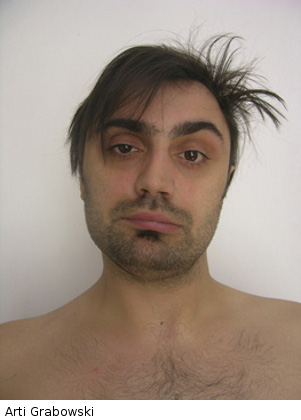
Arti Grabowski's reply to Wladyslaw Kazmierczak's article "Performance-education-fiction" Arti Grabowski, 2011-05-24 While I was a student of the sculpture department at the Academy of Fine Arts in Krakow I always dreamt of having access to places, sources, communities, documentation and in addition the opportunity to show my work. You (Wladyslaw Kazmierczak) and Artur Tajber were the only ones who made it possible, by inviting me to participate. Today I feel obliged to give back everything to anyone who may benefit in the same way. And I have to correct you on a few issues: - Not all young people want to become performers straight away! Ask them! Maybe they simply want to feel something, test themselves or even heal something. It's a great satisfaction for me, when someone says: "thanks, your workshops have really helped me... I found myself opening up towards ordinary everyday situations or contacts with people, and the surroundings..." - it's true, that I may not see him / her ever again in "British or world performance", but has it crossed your mind that sometimes "the students of outstanding performers-professors" don't want to "join in the performance art world"? Perhaps they just want to try something new, use another opportunity, test themselves and perhaps we simply allow them to do so? - I agree that various schools artificially create a few names, but this refers to all fields: artists are being created by galleries or museums, critics or magazines etc. and that "the process of educating performance artists is defective in itself". However, this is just the beginning. Personally I also agree to a certain extent that "educating a performer formally weakens or minimalises his/her emotional tensions that are necessary in fact to build the intellectual structure and position of the performer.", but one of the most important challenges of a teacher is to stimulate the student intellectually and emotionally. - With reference to your comment: most performance art festivals are "simulating art in laboratory conditions" during which "the performer is in touch with an integrated public, however, it is an artistic public (80% comprising of the artists invited to participate), which is gentle, intelligent, understanding, tolerant, competitive and as a matter of fact – indifferent". - I don't agree that "A young performer during his/her studies is deprived of the right to risk artistically and deprived of very strong, emotional experiences". An exceptional student, believe me, very often puts me or Artur Tajber in a very difficult situation on the border of breaking the law or public lynching! - "Time also takes away the joy of innovation - for example it is difficult to come back to one's own ideas" - personally I come back to them with sentiment more and more often. - "A student is saturated with photo and video documentation, literature, knows about types and kinds of performance and knows dozens or hundreds of performances made by performance art icons". – personally I missed that – no Internet, tools, publications... I remember when you threw cold water on my enthusiasm when I discovered an exciting similarity of my ideas with the ideas of Angel Pastor (when we wrapped our bodies in newspapers and various rubbish). I think it is very precious to have knowledge and historical references in order not to waste energy repeating empty "discoveries" such as "I will place a stone on my head" or put bread shoes on my feet. - "A young person, involved in studies usually does not have time for external contacts" – whenever I can, I take a few students and I allow them to use a testing ground, important for every young artist in order to confront with as you call them "environments". Many times this gives them an opportunity for "acute public dialog", as a result I very often had to offer my own neck, but I place that in the sphere of a pedagogical satisfaction. It is not true that if they "are invited, it's in a role of 'lesser performers" – I assure you! A few of them now exist in the actual art market about which I (or I should dare to say WE) may only dream. - I agree that "Young performers (after art school) are usually surprised by the fact that the external world (outside of the art school) is very acute and waits for one's message, imagination, instincts, intuitions and decisions. It is not important what you studied, how long, where and with whom or in fact whether you studied anything at all." – I confirm this as I am a A SCULTUPRE DEPARTMENT GRADUATE and by this I categorically deny all "unauthorised myths that if someone does not graduate from a performance art department, they can’t dream of a profession as performance artist." - I don't agree that only "performers-professors, who function within an academic and financial structure, have access to financial support that allows them to travel around the world" – equal privileges are available to each student, artist or teacher who wants to apply and can browse through the Internet (see: a few of our students). To summarise - one has to have enormous potential, authority and stimulating power to become a convincing performance artist. Exactly the same challenges stand in front of each teacher, so in fact we may have the best predispositions, eh? And in the end: maybe I'm not a genius but I was your student and Artur Tajber's student... you won't change that. Thank you for all you did for me, I will never forget it. read Wladyslaw Kazmierczak's text
|