|
|
Performance-education-fiction
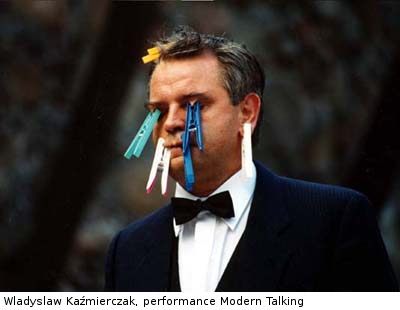
Władyslaw Kazmierczak, 2011-05-17
The process of educating young performance artists that has taken place for over 30 years has become a very interesting issue, evoking both the respect and jealousy of other performers from beyond the education circle. However, after many years it has turned out that the effects of that educational work are mediocre. We are not aware of who is/was an outstanding student of Abramović, Ayers, Beuys, Brisley, MacLennan, Stitt, Hunter, Rolf, Layzell, Arsem, Tajber, Ruller, Fritz, Nieslony or Deimling. The educational practice has not yet created an unquestionable confidfence and trust in the existence of centres in which performers could be educated. When analysing further the causes of this unsuccessful activity we come to the conclusion, that the process of educating performance artists is defective in itself.
Educating performance artists – a terrifying fiction
I have always admired the teaching work of performers-educators who participate in something fascinating, by passing on their experiences to young people. However, disbelief in this noble mission crept in during autumn 1996 in Glasgow, when after the National Review of Live Art had finished, during a group discussion, two young British female student artists accused me of structuring my performances against the rules that they had learnt from art school. I did not have then any sensible answer to the accusation as I did not know, as a matter of fact, what they meant.
The above mentioned student performers have never participated in British or world performance events. Nor have the remaining hundred student-performers who participated in the festival. Their fantastic energy got lost somewhere. I have been looking for some explanation, why is this happening.
After a longer time it occurred to me, that the students of outstanding performer-professors are unable to join in the performance art world, and at that moment I started to observe performance art education and ask more and more questions. The results of this reflection are quite astonishing.
The process of educating young performance artists that has taken place for over 30 years has become a very interesting issue, evoking both the respect and jealousy of other performers from beyond the education circle. However, after many years it has turned out that the effects of that educational work are mediocre. We don’t know who is/was an outstanding student of Abramović, Ayers, Beuys, Brisley, MacLennan, Stitt, Hunter, Rolf, Layzell, Arsem, Tajber, Ruller, Fritz, Nieslony or Deimling and we are not expecting any threat towards established art from the side-lines of these brilliant artists. An exception is offered by the work of Boris Nieslony, BBB Johannes Deimling and Jürgen Fritz who participate in dozens of workshops in Europe and throughout the world. Their activities have nothing to do with the full-time studies about which I am writing, but being engaged for many years in “teaching performance” also provokes the question: what are the results of this activity? I think that a short, intensive and individual form of contact with students is very positive and unaffected by an institutional structure. This text will explain further the dramatic scale of the abyss that divides these two forms of "teaching performance art".
It may also be said that a very harmful category to emerge is the large number of 'fake performers' with teaching positions, who aspire to be a 'CV-performer' in order to acquire immediate profit and status in their teaching careers. This means that after achieving a teaching position in art school, any painter, graphic artist or a sculptor may unexpectedly include knowledge of performances in his/her CV. This causes damage indicating that performance is a lower quality art, and that anyone can teach this diverse kind or art form. Art schools know about this and don't see anything wrong in it.
However we look at the situation, one this is certain. The educational practice has not yet created an unquestionable confidence and trust in the existence of the centres in which performers could be educated. When analysing further the causes of this unsuccessful activity we come to the conclusion, that the process of educating performance artists is defective in itself.
Looking from outside – everything seems flawless. A young person who is interested in his/her professional development chooses a department that is supposed to prepare him/her to exist in the art world. An additional motivation is the fact, that young performers often see the results of positive artistic activities by their lecturer-performers in their closest environment. So the choice seems to be ideal, but the problems start later.
A basic mistake: Educating a performer formally weakens or minimalises his/her emotional tensions, that are necessary in fact to build the intellectual structure and position of the performer. Despite the fact that each academic studio performance takes places live, is really happening and fulfils all the criteria of the genre of performance art, each time it IS SIMULATING ART in laboratory conditions. The performer-student is in touch with an integrated public however it is an artistic public, which is gentle, intelligent, understanding, tolerant, competitive and as a matter of fact – indifferent.
A young performer during his / her studies is deprived of the right to risk artistically and deprived of the very strong, emotional experiences resulting from dealing with a public that is not integrated into art. These experiences are a STABLE STRUCTURE in the process of the individual development of every artist, which develop incessantly until one comes to the conclusion that he / she is or is not a performance artist.
Another enemy of the performer's education is time. A few year of the artistic academic course accustoms performers to create studio work (in rare cases to act in the public space), to some kind of tone and level of discussing performance art and, what is the most dangerous, surrounds young performers with a long-lasting lack of strength of emotion. Time also takes away the joy of innovation – for example it is difficult to come back to one's own ideas. A young person's mind – according to the curriculum – is focused on iconic and historical performances. A student is saturated with photo and video documentation, literature, knows about the types and kinds of performance and knows of dozens or hundreds of performances made by performance art icons. In order to gain this curriculum knowledge, each young person has to invest a few years. However, no school will openly state, that a beginner in performance art does not have to have this historical knowledge in order to make performance art.
Paradoxically, for a performance art beginner his/her artistic environment is an enemy. A young person, involved in studies usually does not have time for many external contacts, and does not have time to develop an independent artistic 'response', because usually he/she is overwhelmed by the studio work of his/her colleagues and the work of the professor –performer, which do not provoke an acute, public dialogue. By not making a broader contact with the world of performance artists during one's studies (because he/she is a student), after graduating one becomes an artist with only local and post-school contacts.
This does not mean, that students don't have the occasion to be invited for various festivals and other gallery performance presentations. However if they are invited, it's in a role of 'lesser' performers. During these events they don't have the feeling of being merited persons/artists. They lose their dignity. They are not equals even in the discussing of art. Someone else decides about their position in the art world. After art school, the only thing that will be embedded in the young artist's awareness will be the fact that he/she studied under a very well known performance artist. Maybe it is a disadvantage or maybe it is a disadvantage over all...
Young performers (after art school) are usually surprised by the fact that the external world (outside of the school) is very acute and waits for one's message, imagination, instincts, intuitions and decisions. It is not important what you studied, how long, where and with whom or in fact whether you studied anything at all.
Students of course do not notice such an obvious fact, that none of their lecturer-performers had finished their studies at a performance art faculty and that each of them entered performance art through a different door. Lecturers and academic department leaders hide this knowledge deeply from the world. They never say that quite a number of outstanding performance artist do not have any degree. That this exceptional kind of art ignores and discredits every certainty. A performance artist may be a philosopher, mathematician, poet, musician, painter or someone from the street, all with the same rights.
Performance-professors therefore play about with students and school authorities in order to fill the next semester with young people. They shift the emphasis of their activities towards education instead of to the real world and they can never be sure what is going to happen next year.
Art schools and art communities circulate unauthorised myths that if someone does not graduate from a performance art department, they can't dream of a profession as performance artist. The notion of a ‘performer's career' is routinely offered by each art school that educates performance artists. Students strongly believe in it. But we don't know what this means to performance art. Ironically, it is for sure a not too precisely formulated ideological vision of a better future. But what kind of future? It is an obvious falsehood, which justifies the spending of quite a large sum of money on the educational studies.
However, a professional career may refer exclusively to performers-professors, who function within an academic and financial structure, have access to financial support that allows them to travel around the world. Institutional finance may allow them to invite other performers from abroad, and above all, their personal input may have influence on the future of young performers. Without students their artistic, material and social position would be for certainly much worse.
Performers-professors also decide about the fate of their academic colleagues who rise up the academic and 'scholarly' ladder. Whoever reads a doctoral thesis of a teacher-performer may afterwards be convinced that the education game is a crazy non-sense. It paralyses our natural responses to undertake discussion or argument. That's why we, performer-non-professors do not make our stand in this unclear environment. Performer-non professors merely act with decency or quiet suspension of the evaluation of the activities of other performers who deal with education.
Admittedly art schools and lecturers in the very beginning, on their web sites define performance as a specific artistic MEDIUM, advising precisely about their position and this somehow later justifies their formal activity. For them, this is the fundamental point on which the whole educational program is built. Without underlining that performance is a separate art medium, creating a teaching curriculum would not be possible. It is a basic discrepancy and an obvious falsification to say, that performance is another medium in art, because it is not!!! There is no reason to call this undefined, pulsating trend in art a medium.
In this context it is interesting that educational gurus of performance art do not tell their students what the most important element of performance art is: the instinct to recognise time, idea, life around oneself, instinct to smell the world and analyse the events happening here and now, readiness to experiment, test one's own views in direct contact with another person. This can't be taught. How to do it can't be prompted how to do it. No one knows.
Certainly it is this ostentatious manipulation that creates and allows for every trick to be included in the educational curriculum structure. Therefore there are various names of departments and faculties depending on their structural academic origin – leaning more towards theatre or visual arts.
A young person who starts performance studies is innocent and most often does not have enough knowledge to notice the trap. Students are constantly encouraged to direct themselves with absolute freedom and work with a lack of rules. This is undoubtedly cool. Everyone knows about it, because we read about this basic method in every book. Everyday practice oozes the so called professors' and their assistants' good advice. Apparently there is nothing wrong in it, but advice given by experienced performers-teachers throughout a few years has a different impact. For example one lecturer tells his students to stare at the ceiling when analysing the space, in which they are supposed to make a performance. Another tells students to bring a stone from outside. Another forbids his students to write texts on performance art. Professor-performers show off with a series of banal prompts at the same time weakening the authentic experience and the necessity of undertaking sometimes dramatic decisions; how to structure a performance in an unknown space, the social or historical context. After a certain time, a beginner performance artist is convinced that in performance there is quite a few friendly, helpful and justified guidelines. The freedom of a young performer is limited by swamping him/her with too much information, examples, tests, exercises, hints, discussions and participating in monotonous studio presentations.
But this is not the end. There are worse situations. Something most hideous that I saw in my life, was the image of a tender, physical stroke to a student-performer on their head by a well-known professor-performer, as the student was approaching her with his/her stress and problems. It was not a one-time incident. This is everyday practice. I am irritated by the situation, in which students are made to demonstrate their excessive emotional trust towards their professors and subject themselves to a stranger, who is paid for educating them.
There are also disgusting opposite situations: one of the most important performance art icons is a specialist in destructing her students and even co-workers. Her sentence: "you are not ready to make a performance" is a deeply distorted statement but it works perfectly – potential artists from her environment have never seriously existed artistically. The famous performance artist-professor in the entire world can make sure that her name will never be used in public.
One last question: when is the critical moment when the graduate of a performance art department that is supposed to prepare him/her to develop their performer's 'career' decided to reject performance art? Undertaking such a decision is dramatic, very personal and presumably it is a very sudden departure. Because in such a decision there is a basic contradiction: a few years earlier I wanted to become a performer, but after graduating from a performance art department, I now don't want to. Are there any exceptions, that some students-performers are later good artists? Yes, there are, there a few of them in the whole world. Andre Stitt, Anne Seagrave, Jeff Huckleberry and maybe someone else whom I don't know. Either by accident or consciously they were not too deeply pulled into the educational. Their readiness to become a performer and to meet another human being was not upset.
read Arti Grabowski's reply
<<< back
|