











|
|
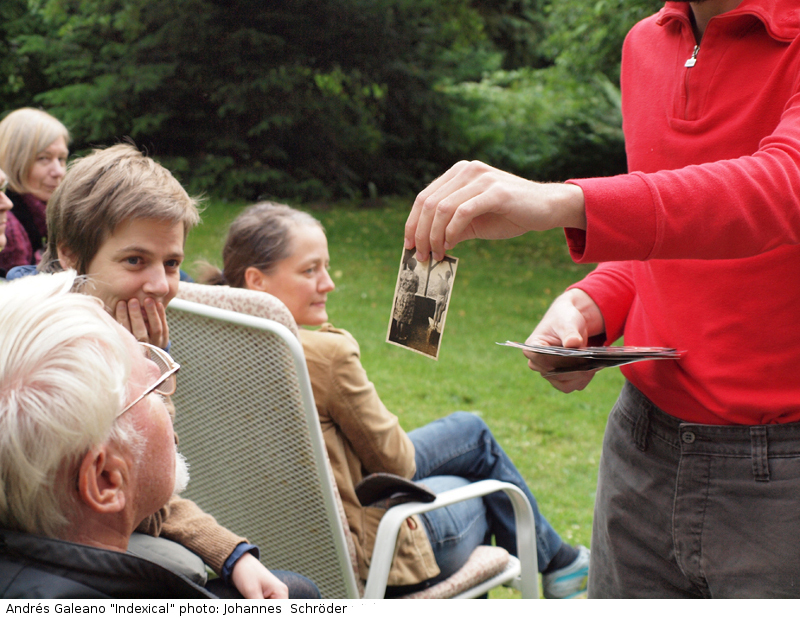
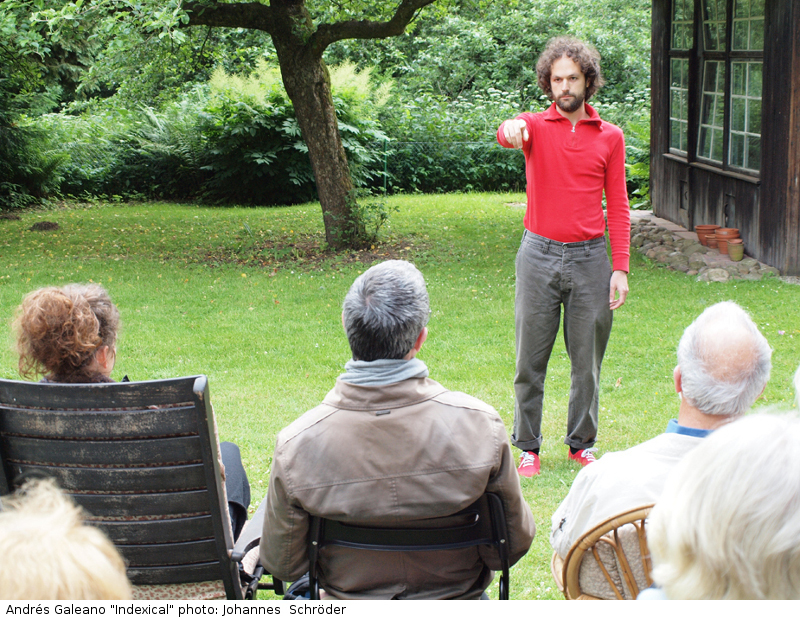
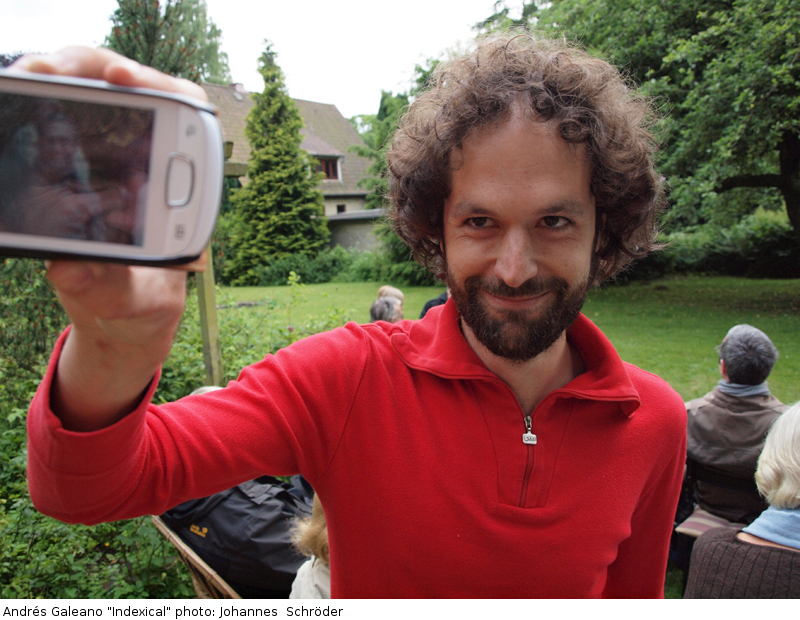
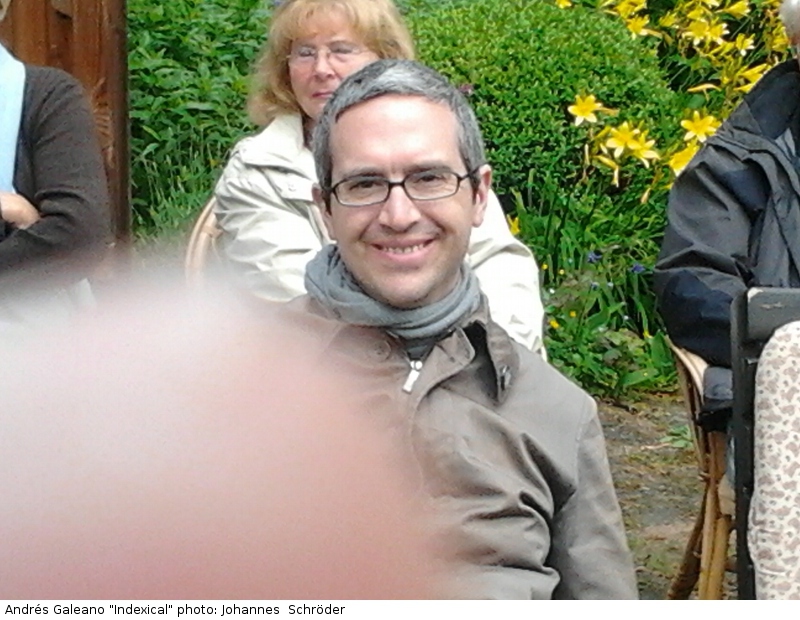
Photographed, Printed, Found, Performed + Photographed. Indexical – a Performance by Andrés Galeano at the hühnerhaus volksdorf in Hamburg1 Johannes Lothar Schröder, 2012-10-04 In 2012 the Spanish artist Andrés Galeano, who lives and works in Berlin, was artist in residency at the hühnerhaus volksdorf from June 7th to 18th. The venue, a former henhouse, is run by Edith Sticker, who transformed it into an art-space in 2009. Since then has featured exhibitions, installations and performances2 and it also participated in the event Architektur Sommer in Hamburg this year. Found Photo Prints in Performances In addition to his installation titled OVAL, he presented his performance Indexical, at the opening weekend of his show. The performance made reference to a series of pictures of people using their fingers to index a point outside the frame. The artist used the theme of indexing as both the doing of an action and a gesture of communication. At first this seemed to be just a banal act, however one must not ignore the artist's interest as a researcher in documenting performances3. With his academic background he was able to select images in which the photographers are witnessing aspects of performativity when taking a picture. Sometimes indexing takes place when a person realises that a picture is taken of him or her and wishes to appear in a more impressive pose. The growing awareness of performance in the public sphere caused an increase in the number of these poses. Galeano underlined this later in his own performance by indexing at a member of the audience, taking a picture with his smart-phone and then showing the picture of this person to every member of the audience. By his action he could specify more aspects of performativity and photography, including the relationship between a passive audience and an active performer, who chose to use the index-finger to underline his role. The presentation of the instant image on the display of his smart-phone outlined a contrast between the previously shown standard photographic prints of samples of analogue photography and the digital photograph on the electronic display. Here spectators had the chance to become aware of not only the picture shown, but also the medium itself, which became a function in the ritual of displaying pictures. This action also goes beyond communication as by reproducing the obvious, the artist was not only presenting his new smart-phone but also presenting the name of the company or trademark and highlighting its status as a trendy gadget. By observing the tools and machines the artist uses in his performances, the spectators can value the status of the artist and his professional competence in relation to the picture and photography as a genre. That's why within certain audiences the gadget can underline the power and superiority of the owner of a tool which is often more effective than the picture or the performance he or she is delivering. Dispositive + Displacement in Performances + Documentary However there is a relationship between the use of documentary photography which is popular in contemporary art and the ephemeral nature of performance-art. First of all we are able to see pictures as evidence of something that has disappeared, something that once only continued to be present by repetition and eventually was given the form of painting as a summary of a performance. That is why photography had an impact on both: the performance and the image.4 The latter one could be reproduced and by the process of being copied it took over aspects of performance – as place and time become the subject of change and in addition there are aspects of performance that can be frozen and thus camouflaged as an image. Observing the impact of photographic reproduction Walter Benjamin was aware of that, and stated that it took away the aura off the original, as it dislocates the artwork by distributing copies of it. When the artwork was exclusively part of a building or a public square it had its function in the rituals. However photographic reproduction dismantled the original, so that it could no longer be kept exclusively separated from everyday life. This made art popular but in the same time its magic was taken away. The act of distribution went into the hands of the owner of a camera, who in a technical process was able to reproduce the original. And as no camera is able to produce images by itself, chemicals, photographic papers, and industries which produce this are required. Together with the act of taking pictures, they form a dispositive which is involved in the entire process, taking over the power of the images. It is the resonance of the aura of the original, which even today leads to the use of documentation as an artwork, as Boris Groys puts it in his essay “Kunst im Zeitalter der Biopolitik”5. This is a topic, which relates to the use of photography in the installations and performances of Galeano. However by using pictures in a performance and by the re-doing of moments and gestures on the found photographs, he relocates the lost place and time in the here and now of his performances. Doing so he defines the power of the re-doing by reviving a moment, a moment which is unknown, place-less, without an index to point to the experience of the photographer and the photographed person. By these magical and ritual aspects, the former ceremonial presence found in original images returns in the ephemeral nature of performance art. Combined with the effort of catching the moment by documenting a performance by the use of photographs, films or video, an endless game of locating and dislocating is driving the rituals of contemporary art practice.
3 The title of his visual arts diploma thesis at Berlin Weissensee in 2011 was: “Performancedokumentation als Kunstwerk/Documentation of Performances as Artwork”. 4 It is pitiful that this aspect was left out in the book Performance und Bild/ Performance als Bild by Christian Janecke, Berlin 2004. In his introduction Janecke pretends explicitly that ephemeral acts in art-history „Bilderprozessionen, barocke Liturgie, Feierliche Enthüllung von Gemälden“ have to be left out (p. 13) as well as their anthropological and ethnological implications (p. 42). As he prefers to proclaim this in an ironical tone, one cannot expect to find a passage on amateur photography. In the contrary, he jokes about photography, which has gained growing attention in exhibitions since 2000 (p. 42/3, note 58). This seems a little arrogant as he pretends not to see a contradiction between performance and photography, when stating after Derrida, that the image is an object of constant change (pp. 45), and therefore – dialectically seen – a performance is an act of high stability. 5 „Vom Kunstwerk zur Kunstdokumentation,“ in: Documenta 11, plattform_5, Ausstellung, Kassel 2002, pp. 107-13, 110ff |