











|
|
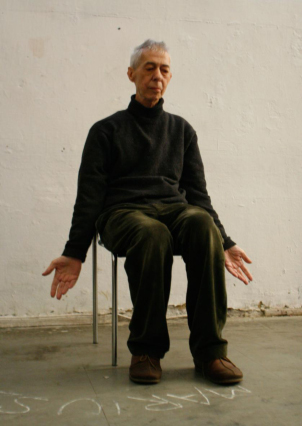
An interview with Jan Swidzinski Lukasz Guzek, 2011-02-07 One of the most important artists and art theoreticians in Poland - Jan Swidzinski says: "The main difference between art now and in the past is that the role of the spectator was to recognize what the artist wanted to say. Spectator or listener had no active role. Today he does. He is incorporated into the work, as in performance art, or has freedom of interpretation. He is able to find something in art just for himself. Because everything changes so quickly, our meetings are short, so what really matters are space, time, ambience; not some kind of permanent being, but being in the exact moment, here and now". Lukasz Guzek Jan Swidzinski Performance activity in Poland started at the I AM festival in 1978, organized by the Remont gallery, directed by Henryk Gajewski, with whom I closely cooperated. It was formally a student gallery, so older people like me or Zbigniew Dlubak were advisors, supervising that undertaking from behind. During my first performances I surrounded myself with chairs and then scattered them. In these times it had a political context - that we need to release ourselves from what surrounds us. It was in 1976 in Krakow, in the Krakowska Kuznica gallery, which had left-wing tendencies, run by the late Stanislaw Urbanski. Then in 1980 I took part in the festival organized by him named "Contact. From propaganda to contemplation", which also took place in Krakow. In 1979 I made a performance in Canada. The meeting was organized by the French collective, L’Art Sociologique working in Calgary. During this time, my book Art Society and Self- consciousness was published there. From there I went to the Western Front in Vancouver. In 1985 I was in the Western Front and Halifax, where my stay was organized by Bruce Barber. My important performance in Poland was Blurring in Lublin in 1984. I blurred a text drawn on the wall, which also had its political context. In the 1980s I started to make more performances. I took up performance art because of my contextual theory and my experience with dance, using body movement and gesture to make a performance. For me a text, an installation, photographs, an exhibition that comes from it all and live action create full composition. It is, however, characteristic of art nowadays.
J.S.
J.S. But our reality is also like performance art. I remember when I was in New York, there was an artist who was walking with a long stick in colorful stripes all the time. It was his action. He was Andre Cadere. He is mentioned in Paul Ardenne’s book Contextual art as an example of an intervention in urban reality. In Poland such interventions were done by the Academy of Movement (Akademia Ruchu). Take another example: today films are being made very easily. We are not concerned about the way they are made (as in structuralism) but we have to capture the moment of reality. This activity has a character of a performance – that is a temporary one. Another example are installations – artists today are different from those from the first half of the twentieth century, because they are not attempting to create something pretty, but something opposite – because beauty is not the topic of art now. Duchamp’s ready-mades are also a kind of performance. Today very different things are considered to be art. |