











|
|
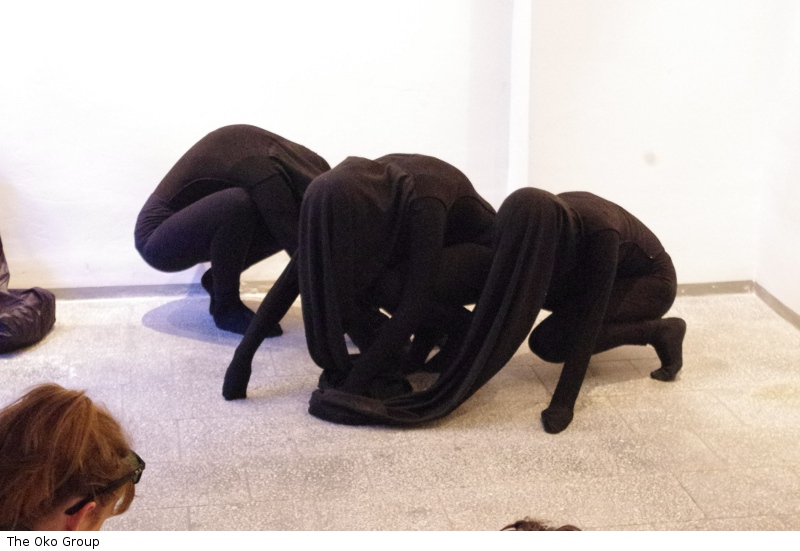
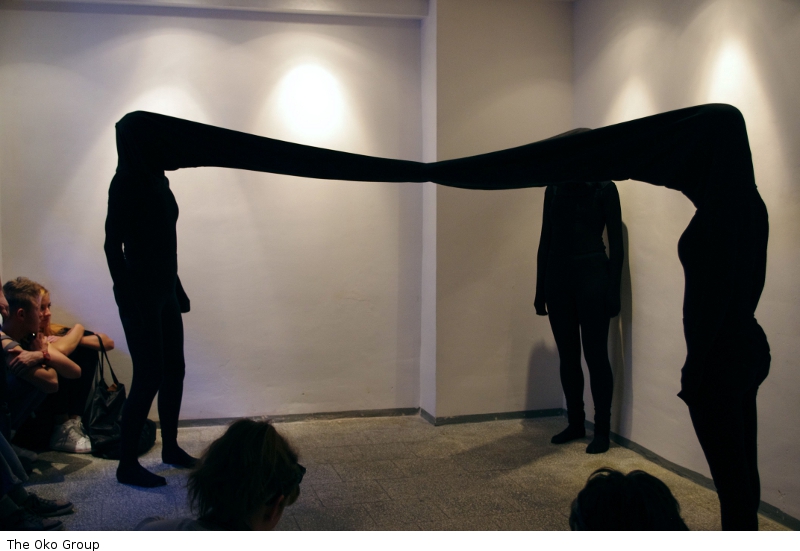
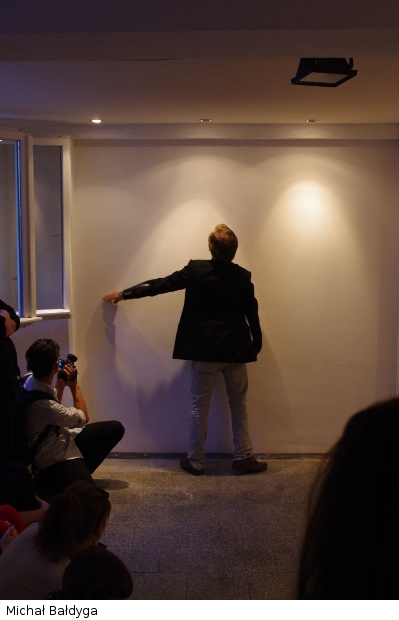
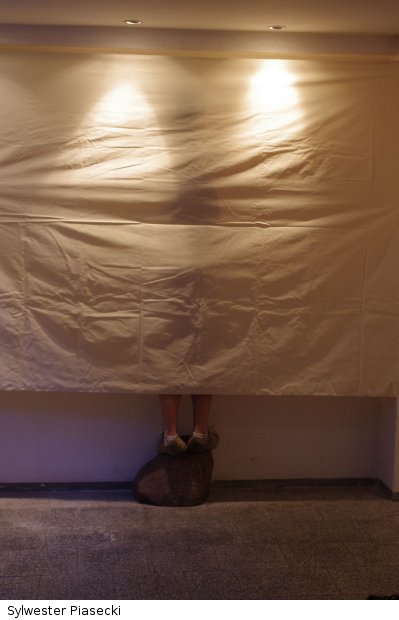
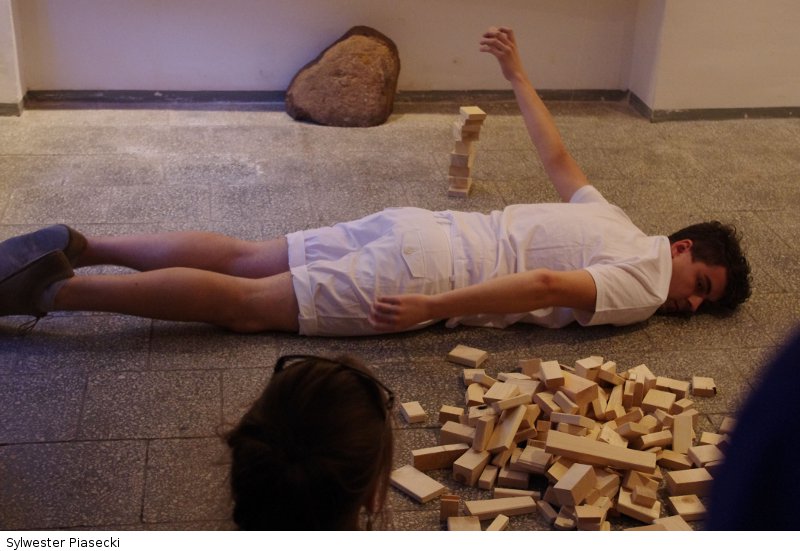
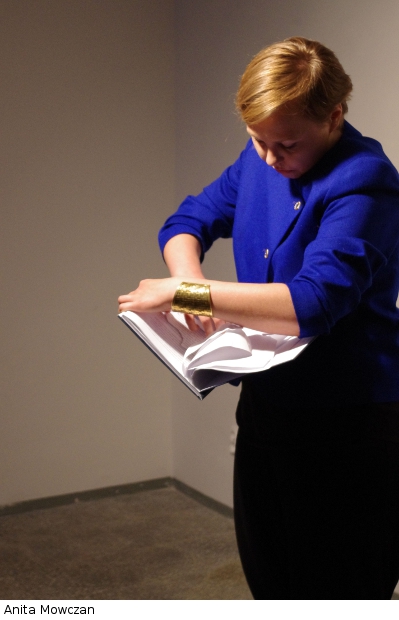
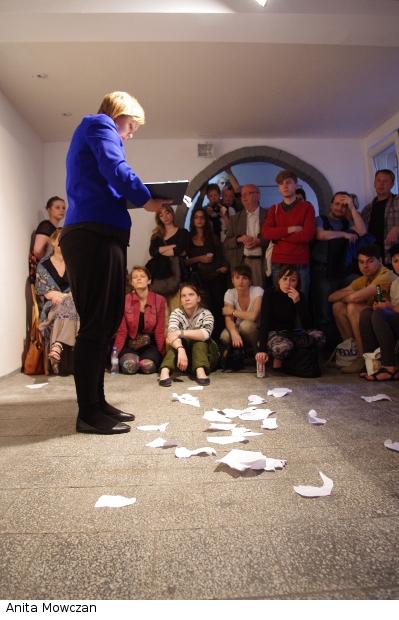
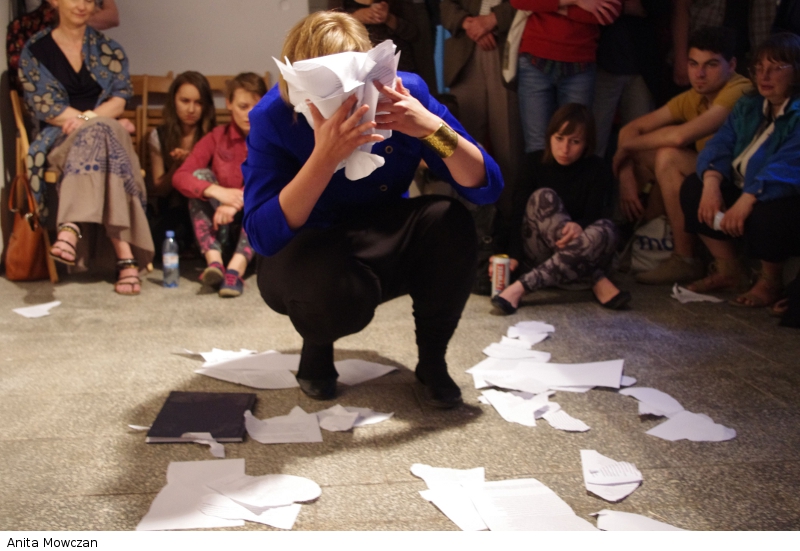
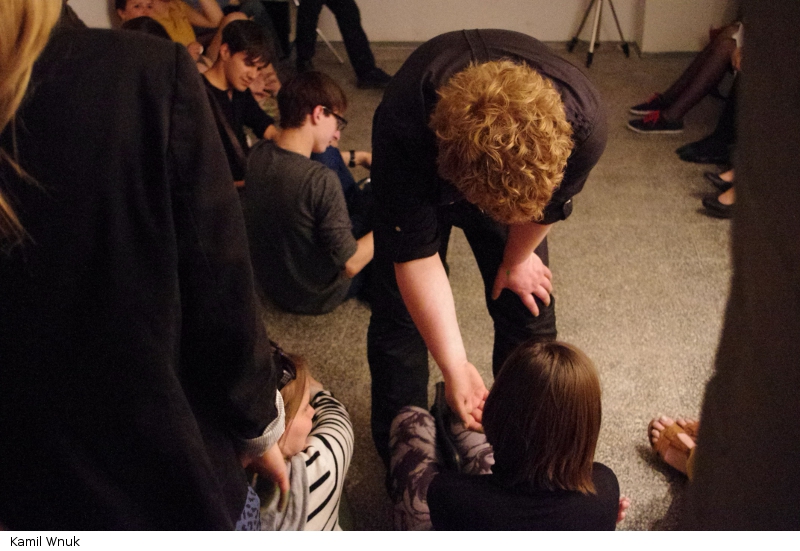
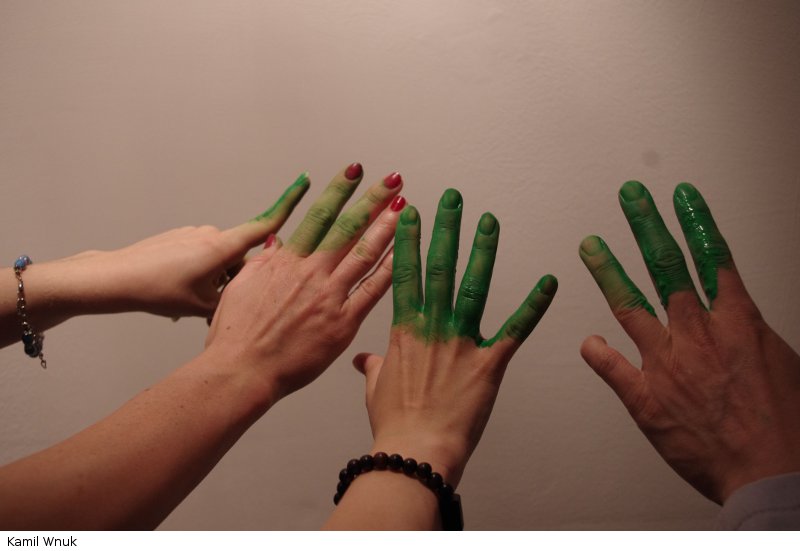
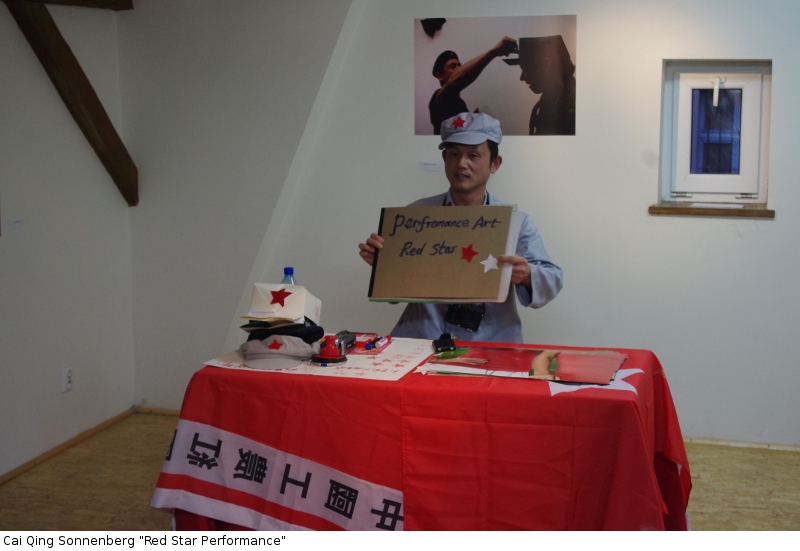
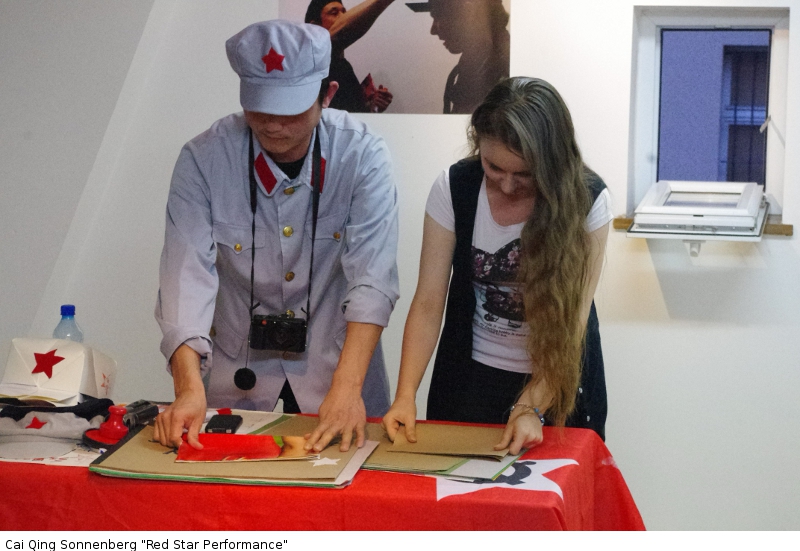
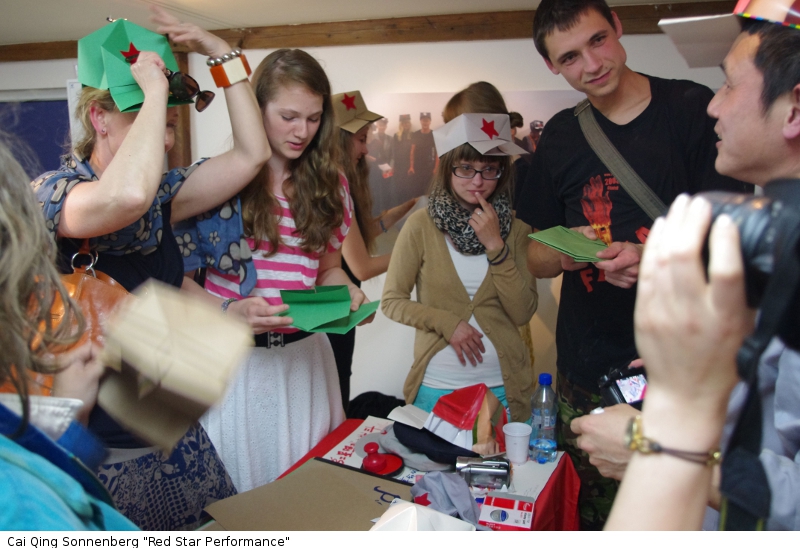
Again and again. First anniversary of the Raczej Gallery (Poznan, Poland) Agnieszka Szablikowska, 2012-08-02 A first year is believed to be the hardest one. An anniversary is an opportunity to celebrate, but it also means an uncertainty of what is yet to come. In other ways, it is just a year that has passed. Behind us there lies already a wide variety of projects, in which performance art was a leitmotif, that is why during our first birthday event we decided to present some ephemeral art. However, this time we invited artists, who like our Gallery, are associated with Poznan plus a Chinese artist, who was staying at the residency in the Raczej Gallery. The first performance gave a strong beginning to the evening. The Oko Group members wrapped their bodies in a textile structure and created a moving, animalistic object. The Oko Group consists of three University of Arts graduates: Ola Grunholz, Klaudia Jarecka and Olga Ozieranska. During their action they were combined into one organism that performed slow movements trying to find a common space for themselves. The artists created an entity that pulsated with their breathing, forming an object that moved like an animal, separated from the viewers. The visual effect of this black, slowly blossoming object, contrasting with the bright gallery space was compounded by the increasing sound of the performers' breathing. Finally, just as it seemed that the action with it cyclical character was coming to an end, there was an increasing guttural sound, intensified by an echo caused by the walls of the room, which was produced by the artists altogether. The performance contained some kind of biological elements, that arose from the movement repetitions and used forms that seemed to refer to some unspecified plants and creatures. The culture of a religious gesture was the main element of Michal Baldyga's performance. He outlined his presence in the Gallery through a series of movements, beginning by marking a sign of the cross using his left hand. After that, with simple gestures he started to trace the lines connecting outer points of the cross sketched in the space. The action gradually lost its connection with the ritual of salvation and become reduced to just a few smooth hand movements. Beginning with new lines, the artist started to make different signs -of infinity; thus he returned to the symbolic meanings. Finally by performing only minimal hand movements, he limited his action to a straight line marked by two points and again returned to marking the sign of the cross. The cycle was repeated and completed. In the same space used by Michal Baldyga, the next artist began his performance. The performance by Sylwester Piasecki was divided into two parts - each of them represented a trial of his own physical capabilities in contact with selected items. During his action he interacted with two materials – stone and wood. It was not an attempt to overcome his own limits, but rather some kind of experimentation. The aim was to inquire what was going to happen in a given situation in that specific time. He was dealing separately with each of the materials used. In the beginning he balanced on top of a stone, hidden behind linen fabric. When he fell down, he resigned from further effort and moved on to stacking wooden blocks. By those attempts the artist raised the issue of the borders between success and failure in performance. A question arises as to why he used those specific natural materials and how many more of those experiments could have been made. "I do not agree to share". That was the only full sentence said by Anita Mowczan - a University of Arts' student - during her performance in which she violently attacked her MA thesis by snatching big pieces of pages. And thus, page after page some authors such as Wojtowicz, Ferenc, Olechnicki, Wolynski or Dziamski landed on the floor. What is borrowing? Where does our own research work end and the use of other sources begin? The artist destroyed that which is the main goal of our university education. Finally, using a gesture that was not even necessary to be able to read the meaning of the performance, Mowczan covered her eyes with fragments of the sheets containing quotes collected from the floor thereby leaving the only remaining author of the work as herself, under the influence of others. Kamil Wnuk was a little surprising. Not by his performance, but by its result. He initially confronted the viewers with darkness. In the beginning the course of events could be anticipated only by judging the reaction of individuals in the room, who loudly expressed their surprise or disgust. One could experience or gradually see with the eyes accustomed to the darkness, the action of the artist who was carefully licking the hands of those who participated in the performance. Eventually the performance ended when one of the participants definitely refused to have their hands licked. The act of licking one's fingers had some intimate connotations and it carried mixed feelings of amusement, embarrassment or confusion. The action would not have had any further content if not for its surprising visual effect - when the light turned on all the participants marked by Wnuk had their hands coloured green. The last event of the evening was the performance by a guest of the Raczej Gallery - Cai Qing Sonnenberg from China, who now lives in Singapore – a middle aged performance artist and teacher. His performance was dominated by the colour red. In Poznan he continued his series called Red Star Performance that he has developed for several years. He invited the audience to make paper hats. Sitting behind a desk, Cai Qing first spoke about his project, which dates back to the Documenta in Kassel in 2007. Cai Qing has tried to disassociate the meaning of the red star in order to treat it as an attractive logo, not as a communist symbol. Each of the participants, who makes his/her own hat, has a star stuck on its front and the artist takes a photo of the person to document the whole project. The intention of the artist is to engage and document as many participants as possible. Also, in the Raczej Gallery we could see earlier parts of the project, in the form of an exhibition of images. Cai Qing has used the potential of the red star in pop culture, as it is used on popular T-shirts with Che Guevara. Despite the integrating and entertaining nature of the action, the red star has such a strong connotation that, especially for people living in a former communist country, such "fun" may also cause negative emotions. He also refers to the history of his country, pointing out that China, which according to many forecasts will "flood the word", is still firmly rooted in the communist system. Although it may be stereotypical, it is hard not to attempt to summarise a year of the Gallery's activity. Over the past year at the Raczej Gallery in Poznan, without much financial support and with a limited number of people involved in organisational efforts, we had an opportunity to present over twenty artists from six countries. In particular, we are happy that each subsequent event met greater interest and attracted new audience to the Gallery. We would like to contribute to an increase in the space for performance art presentation in Poznan. Unfortunately, the majority of Polish galleries exist for only about two years, although I hope that we will continue and celebrate not only the second, but the third and subsequent anniversaries. |