











|
|
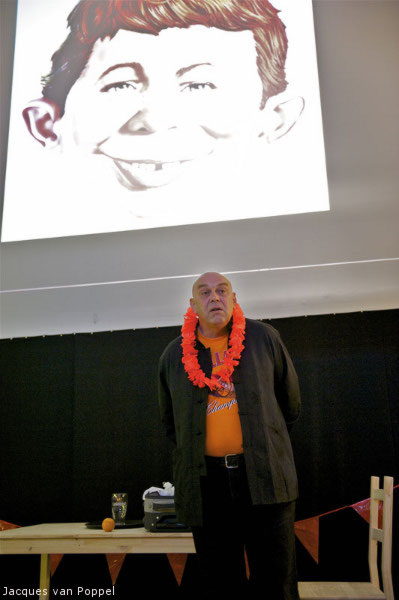
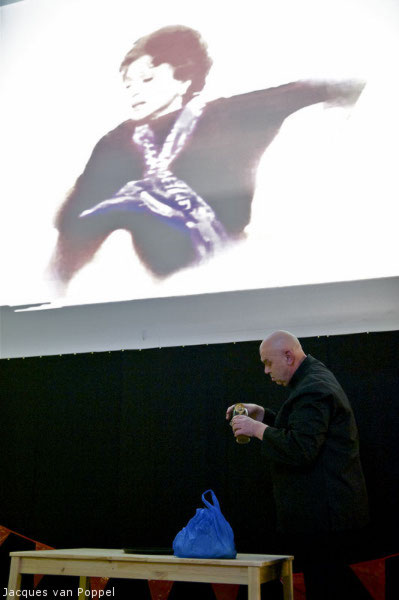
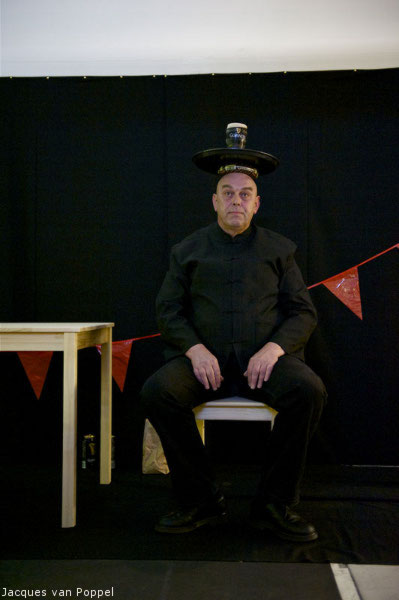
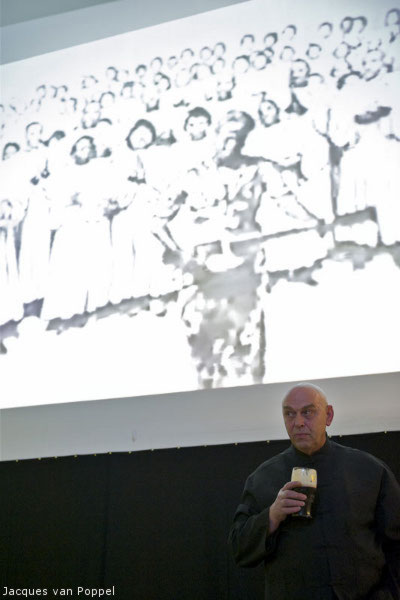
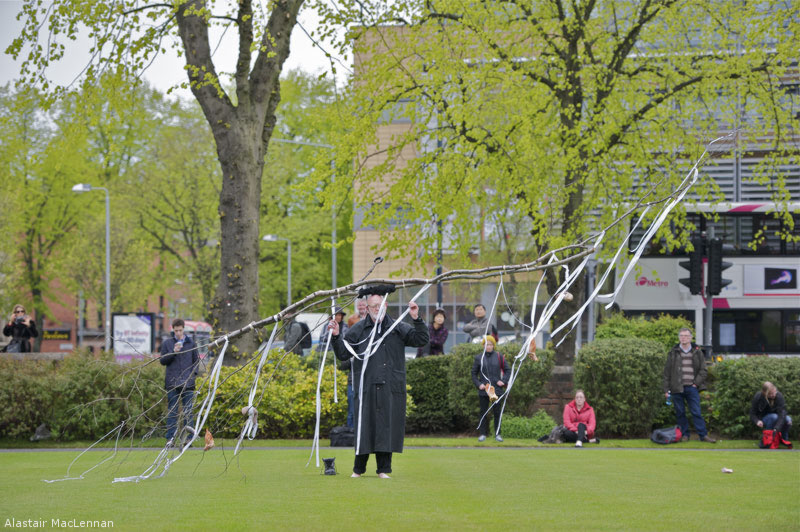
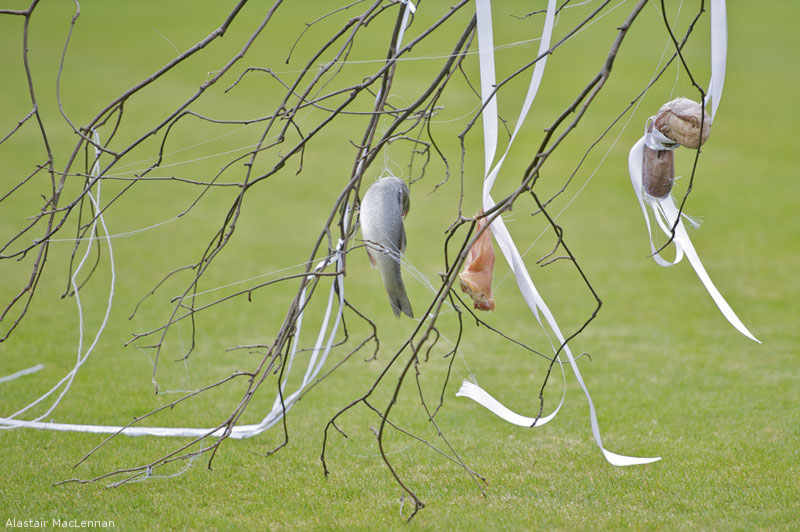
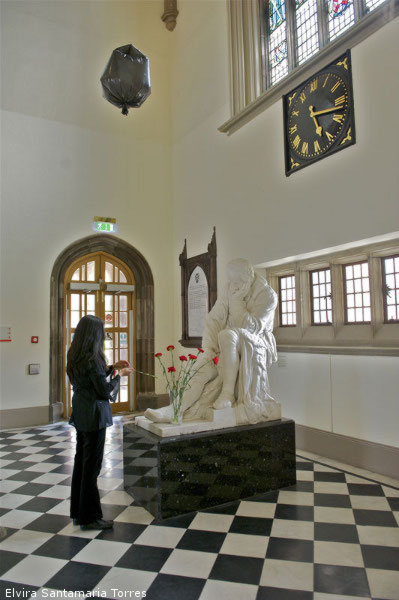
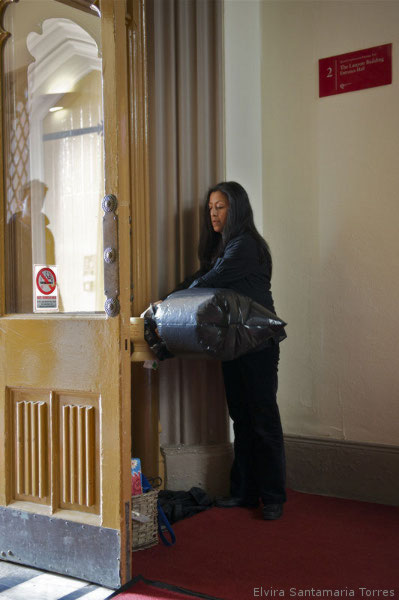
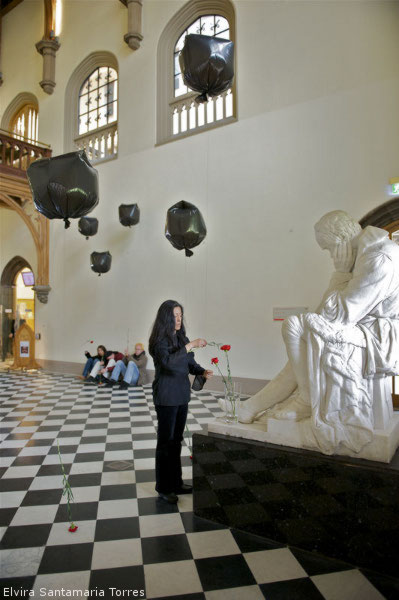
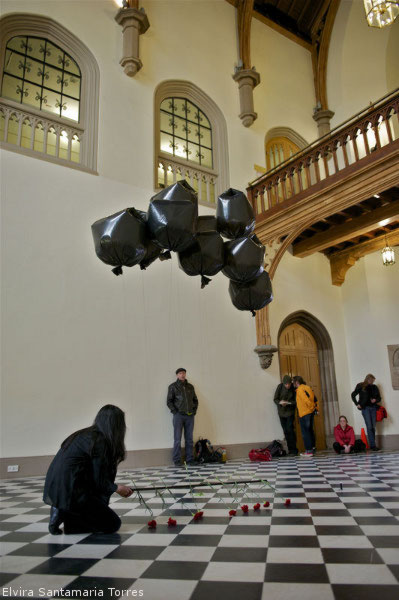
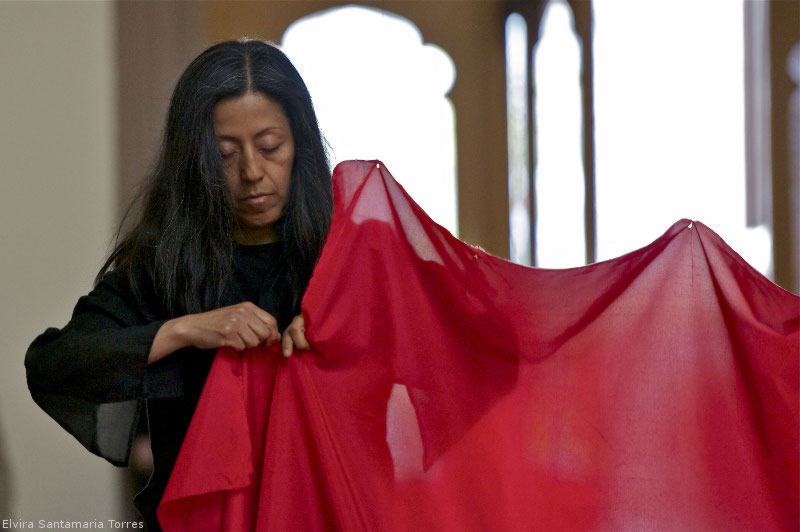
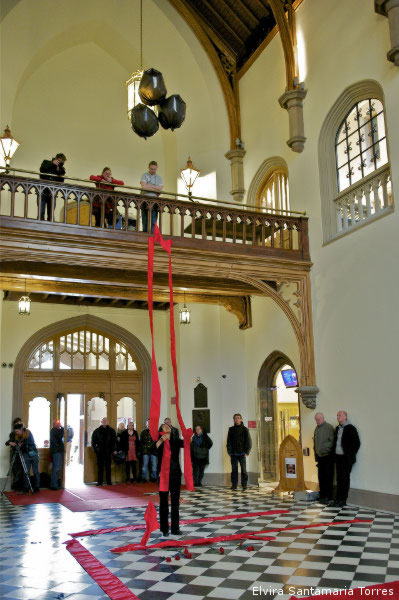
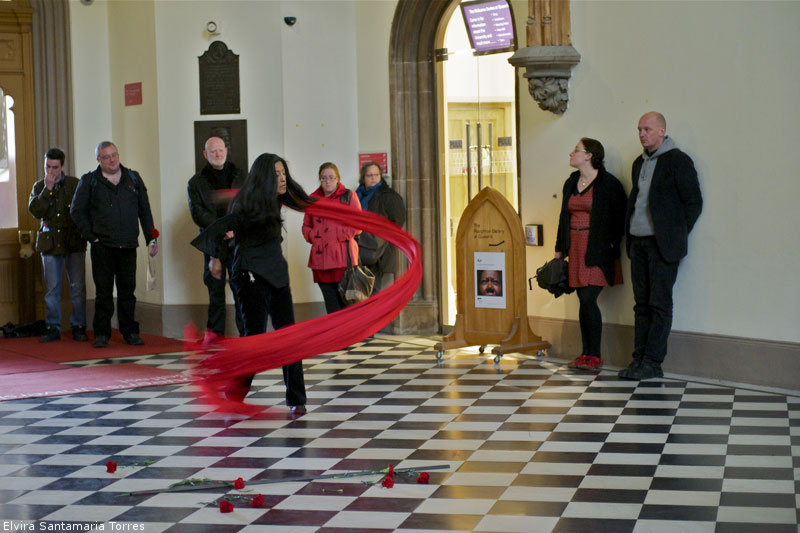
Show, Slow, Flow - performances by Jacques van Poppel, Alastair MacLennan and Elvira Santamaria Torres in Belfast Slavka Sverakova, 2012-06-15 Six Days of performance art and video was an event organized by the Naughton Gallery at Queens, Belfast during the week from 30th April until 5th May 2012, in collaboration with Bbeyond and Black Market International. I have not seen all performances, consequently this is not a review of the event. I watched the beginning and the end, only. The launch at the Queens Film Theatre on Monday evening felt like a family affair, the audience consisted almost entirely from other performance artists, local and invited, who knew each other, or of one another. Their predictably friendly and positive responses were slightely fractured by curiosity and expectations what the performing master will present. Belfast is not quite a backwater when it comes to performance art, yet, there has been always reluctance to be critical of the performance art, treated almost as endangered species. Even this time, politeness towards visitors suppressed any critical thought into the privacy of relaxed smiles. Beguilingly, my three cases fall into a gnomic rhyme: show slow flow. SHOW Jacques van Poppel is not a stranger to an intimacy afforded by offers of drinks to his audience (as in his peripatetic moving from a person to person with a bottle of juniper spirit at the closing performances on Saturday), nevertheless he chose a public mood for the performance that inaugurated the week long event. He dedicated the last part to a member of the Black Market International, the Suisse artist Norbert Klassen, who died in 2011, a series of dual portraits. Before that van Poppel balanced a tray with the glass full of beer on his head illustrating one of the BMI's rule: don't give up control. The tempo and gravity of the closing part suited the memorial motive, while the opening part strangled any deep held emotions by frivolous challenge to habits and traditions. Issuing a challenge to the regional obsession with orange and green colours as symbols of conflict, allowing his orange shirt, orange bracelet, orange fruit, orange bunting to free the colour from the severity of tradition, he closed the passage by taking glasses from the orange case "for reading" and from the green case"for a distance". Despite the ambiguous generalisation the distinction cut through. Either orange stands for knowing and green for taking a longer perspective, or, constructed as a critique the "orange follow what is written/known" and the "greens envisage future without paying attention to the here and now" In between this excursion into history and the memory of Klassen, a projection of a jazz/gospel singer, in a black and white, slightly grainy film, elevated the vitality of music, singing, of art as life supporting quality. Jacques van Poppel is a musician, I sense that the composition of this performance is like a sonata form, with different tempo in each of the three parts. In the orange part he spoke casually as if amongst a small family gathering, moving from one motive to another, not lingering on any, like a stand up comic or raconteur. The second part, the song, was a pure theatre/vaudeville, carried by repeats of refrain. During the last part, the memorial for his friend, he fell into a silent decrescendo and alternation of the mood. He started like a stand up comic, connecting with the audience by staccatto of a succession of moves: stand up, open coat, show the shirt, put on the bracelet, hang the bunting on the wall. The next phase introduced large chords of movements ending including sitting upright carrying the tray with beer on his head. An acrobatic act. Drinking a large glass of Guinness linked to a fluent change into the last mood, the memorial for the dead artist.It could have ended on one portrait of Klassen. Instead, a quick succession of many, allowed for multiple views of Klassen alive. The performance was tightly controlled, its timing, flow, rhythm, duration. Yet, seemingly casual. It reminded me of jazz improvization grounded in inspiration. It included a tranquil vignette reassuring the missing friend that he is still a part of the show. SLOW On Tuesday, Alastair MacLennan carried a heavy burden on his head for an hour. Two large dead branches were decorated with white ribbons, some holding animal parts, like tongue, pig ear, and a whole fish. The heavy burden pressing on his head, the weight capable of destabilising him as the vertical bearer, presents a recrudescence of an ascetic custom as means of reparation for the "sins of the world". Under a severe discipline MacLennan delivers the meme of penance without inducing his audience to join. There is no ecstasy. Like a wandering dervish/flagellant he presents the concern dissolving form into living situation seemingly disregarding the power of the action, replacing it by numinous gesture. Pulling the ribbons to balance the weight of the branches he prevents visual disembodiment of objects from his body, as if a numen inhabited the dead parts of a tree to grant the performance. FLOW Elvira Santamaria Torres prefers rapture and fragmentation to illuminate special point about known phenomena. It is reminiscent of Giordano Bruno (1548 -1600) exultation: throw away the thorns and nettles of your creeds, enjoy the perpetual miracle of life. Both in his discourses and plays Bruno appears both similar and different from most of his contemporarie, including Galileo Galilei, whose statue, by Pio Fedi (1816 - 1892) was included in this performance from the beginning. Torres, dressed in black, faced the sculpture in front of which she placed a bouquet of red carnations, later used one by one as "anchors" for the inflatable black voluminous forms. After several contemplative minutes she walked numerous circles increasing in size, away from the statue. The particular became privileged: the geometry and materials. The nearest conceptual link exists to The New Sciences, written by Galileo when under house arrest. As if illustrating The Assayer, Torres let the black "baloons" carry the carnation up to the ceiling, eventually. She left her postion and turned her back to the sculpture only when she filled the black shiny bags with gas, one at the time. All the other actions she performed facing Galileo. The black thread and scissors came out of her pockets, she twisted the material to stop the gas escaping, secured it with the thread that was almost invisible, and attached a carnation. She asked some members of the audience to hold the end of the thread. When all the bags were filled, a red curtain was attached to be lifted up, an experiment in kinematic law. The materials used defeated the expectations. Torres freed the black bags to ascend the celing on their own. On one hand it could be constructed as an error in calculation of weights, on the other as courage to tell the truth when it is opposed to the intention, for instance. Afterwards,Torres worked the red cloth as if creating a dance of the veils. This and the flowers, evoked memories of Torres's earlier performances. Torres imbued the flow between intention and spontaneity as an interaction of law of physics and performance, with poetry. Perhaps, not an alien idea for Galileo who studied music an drawings in addition to observational astronomy.
|